California's 2026 governor's race already has more than $162M in political money moving through it. But the more interesting question isn't just who raised the most. It's whether their donor networks match what they say they stand for.
Most voters are not campaign finance analysts. They should not have to dig through raw filings, donor names, occupation fields, independent expenditures, and committee reports just to understand who is backing the people asking for their vote.
So we lined up eight of the leading candidates in the race: five Democrats and three Republicans. The goal is simple: help voters understand who's running, how much money is behind them, where that money appears to be coming from, and what contradictions may be hiding inside their donor networks.
This is the kind of analysis BallotBase is built for: turning raw campaign finance filings into readable political intelligence.
Here's who's serious, who's funded, and what their donor networks actually reveal about their priorities.
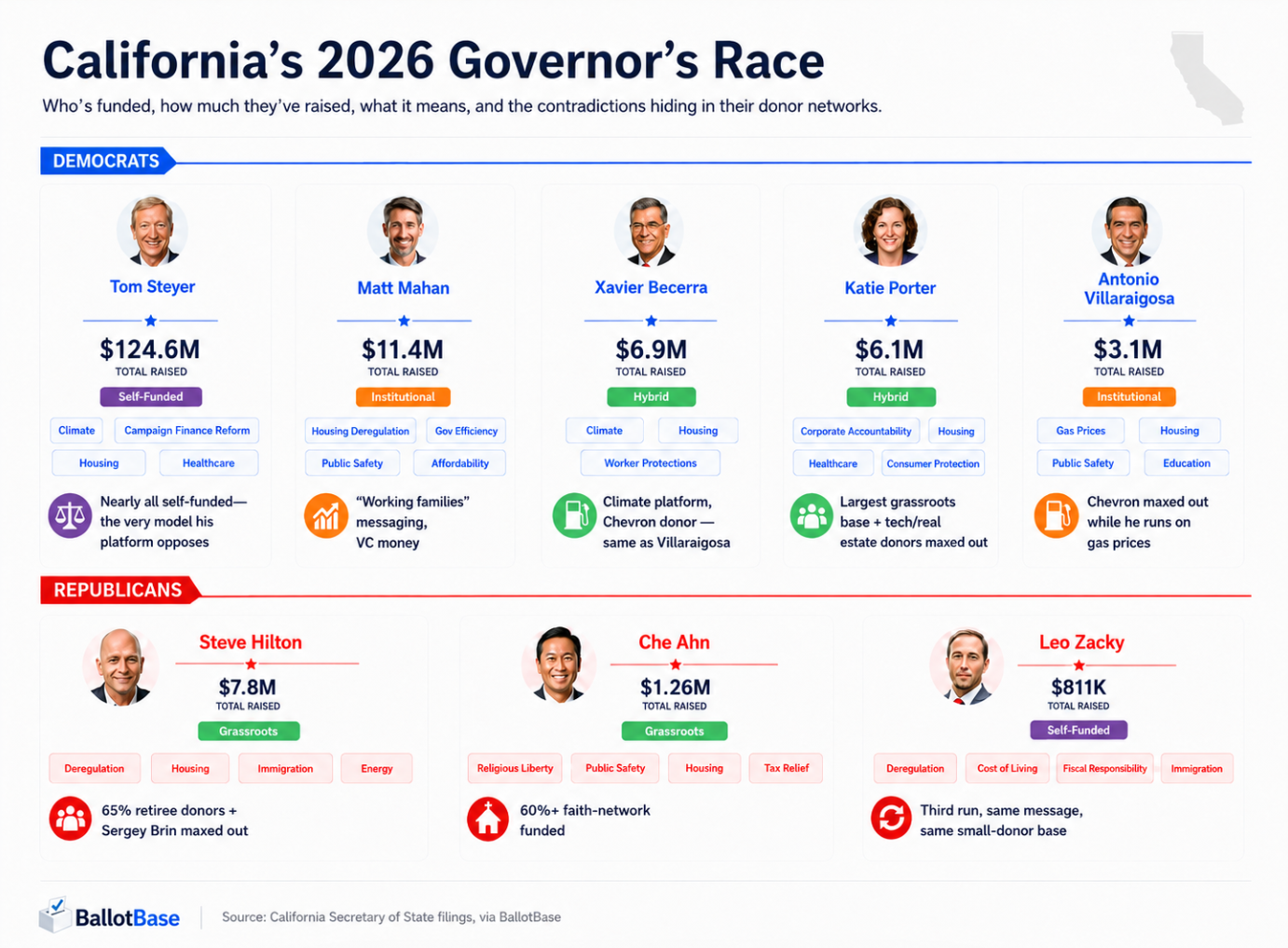
The Democratic Field
Tom Steyer, $124.6M Raised
Platform: Climate policy, campaign finance reform, housing affordability, healthcare access, reducing corporate influence in politics.
Steyer has more money than the rest of the field combined. Of his $124.6M total, roughly $28M comes from direct personal contributions to his campaign committee; the bulk of the remainder is independent expenditure committee spending aligned with his causes, much of it tracing back to Steyer-funded climate philanthropy. His named secondary donors are investment managers and climate-focused nonprofits: Meritage Group LP, High Tide Foundation, Cool Effect.
There's genuine alignment on climate. His philanthropic background shows up in who writes the checks. But his platform includes reducing corporate influence in politics, a difficult message for a campaign built primarily on one person's fortune. The funding model is the exact thing the platform opposes.
The contradiction that stands out: Running on reducing wealthy influence in politics while being the wealthiest self-funder in the race.
Matt Mahan, $11.4M Raised
Platform: Housing deregulation, government efficiency, public safety, business-friendly economic policy, working family affordability.
Mahan entered the race late and built his war chest almost entirely from Silicon Valley. Y Combinator, Mark Pincus, Sean Parker, Kyle Vogt, the who's who of tech founders and venture capitalists.
His platform emphasizes deregulation, housing reform through market mechanisms, and government efficiency. That aligns cleanly with his donor base. The tension is in his "working families" affordability messaging: there are essentially no working-class donors, labor organizations, or community groups in his fundraising. His donor base is primarily founders and angel investors, people for whom "self-employed" is the standard filing.
The contradiction that stands out: "Working families" messaging, venture capital money.
Xavier Becerra, $6.9M Raised
Platform: Climate and clean energy, affordable housing, healthcare access, worker protections, consumer rights.
Becerra has made climate a core platform issue. Chevron USA Inc. has maxed out to his campaign at $39,200. He also has substantial real estate developer support while running on housing affordability.
His grassroots base is real: large portions of his fundraising come from self-employed and not-employed donors, and his healthcare sector support aligns with his background as former Attorney General. But the institutional money tells a more complicated story.
The contradiction that stands out: Two Democratic climate candidates, same fossil fuel donor, same maximum check.
Katie Porter, $6.1M Raised
Platform: Corporate accountability, affordable housing, healthcare costs, consumer protection, working family economic relief.
Porter has the strongest small-dollar fundraising base in the Democratic field. Tens of thousands of individual contributions form the bulk of her direct donations, and that grassroots support is real.
But among her named contributors at the legal limit: tech executives, healthcare executives, and real estate developers. Her platform centers on holding corporate interests accountable. These are exactly the kind of donors her rhetoric targets.
Labor unions have also spent heavily on her behalf through independent expenditure committees, which aligns with her progressive positioning.
The contradiction that stands out: Anti-corporate platform, tech and real estate executives maxed out at the legal limit.
Antonio Villaraigosa, $3.1M Raised
Platform: Gas prices and energy costs, affordable housing, public safety, education reform, economic opportunity.
Villaraigosa has made gas prices a centerpiece issue. He's also accepted contributions maxed out at the legal limit of $39,200 from Chevron and support from California Resources Corporation, the state's largest oil producer.
His broader coalition is establishment-centrist: healthcare providers, construction unions, private equity firms. The labor union backing reflects his Democratic establishment roots. The fossil fuel money is harder to explain.
The contradiction that stands out: Running on gas prices while Chevron is maxed out at the legal limit.
The Republican Field
Steve Hilton, $7.8M Raised
Platform: Deregulation, housing reform, immigration enforcement, energy independence, government accountability.
Hilton's donor base is striking for a Republican: more than 4,000 retired individual donors contributing over $2.6M form the backbone of his grassroots support, the most genuinely grassroots conservative fundraising profile in the field. His institutional backing comes from real estate developers, construction, agriculture, and energy.
The surprise: Alphabet co-founder Sergey Brin maxed out at $39,200, and crypto platform Ripple contributed $78,400. For a conservative deregulation candidate, that's a notable cross-partisan tech signal.
The tension: his housing platform and his developer donor network don't always point the same direction. Developer-friendly deregulation and genuine housing affordability are related, but not the same thing.
The donor profile: Grassroots retirees plus targeted sector money, real estate, agriculture, energy, with unexpected tech wealth on top. No major institutional PAC backing, which is unusual for a top-tier Republican gubernatorial candidate.
Che Ahn, $1.26M Raised
Platform: Religious liberty, public safety and law enforcement, housing affordability, tax relief, parental rights in education.
Ahn's campaign is faith-funded. Harvest Rock Church and affiliated Christian conservative networks account for over 60% of identifiable major donations, supplemented by real estate professionals and small business owners.
The platform alignment is clear: religious liberty and law-and-order issues draw genuinely from his donor base. The tension is in housing, he's accepted contributions from real estate interests while including affordability in his platform. Developer money and housing affordability don't often travel together.
The donor profile: A faith-mobilized conservative campaign with real estate money on the side.
Leo Zacky, $811K Raised
Platform: Deregulation, cost-of-living relief, fiscal responsibility, immigration enforcement, water and agricultural policy.
Zacky is largely self-funded with a secondary base of small business owners, ranchers, and agricultural interests. He's running on deregulation and affordability, a platform that matches his donor profile almost perfectly, for better or worse. This is his third run for governor.
The donor profile: Grassroots small-business conservative with no institutional backing and a consistent message across multiple cycles.
What Does the Money Tell Us?
A few patterns emerge across the entire field:
Self-funders vs. coalition builders. Steyer is in a category of his own, more money than the rest of the field combined, almost entirely through personal wealth and aligned outside spending. Mahan has built a strong Silicon Valley network. Everyone else is doing some version of coalition fundraising, though what that coalition looks like varies a lot.
The grassroots story is split. Porter has the strongest small-dollar base on the Democratic side. Hilton has the strongest on the Republican side. Both are real, but they look very different: Porter's small donors are progressive and broadly distributed; Hilton's are concentrated among retirees.
The Chevron problem. Both Villaraigosa and Becerra are running climate-forward platforms while accepting maxed-out contributions from Chevron. Voters who care about climate should ask both candidates about it directly.
The housing contradiction. Nearly every candidate, Democrat and Republican, has real estate developer money while running on affordability. California's housing crisis is everyone's issue, but the donor networks suggest complicated relationships with the development industry.
The Republican gap. Hilton has $7.8M. The next Republican is at $1.26M. If the GOP wants to be in the November runoff, Hilton needs to be the consolidation candidate, and fast.
Why This Race Matters
California's top-two primary in June means the two highest vote-getters advance to November, regardless of party. With this many Democrats in the field, vote-splitting is a real risk. The candidate who consolidates institutional money and grassroots support wins June. The money race suggests that's still very much unsettled.
This is the kind of analysis BallotBase is built for: turning raw campaign finance filings into readable political intelligence.
All data sourced directly from California Secretary of State campaign finance filings via BallotBase. We pull from the same raw data exports as Cal-Access, typically updated before the official website reflects new filings. Data current as of May 2026.