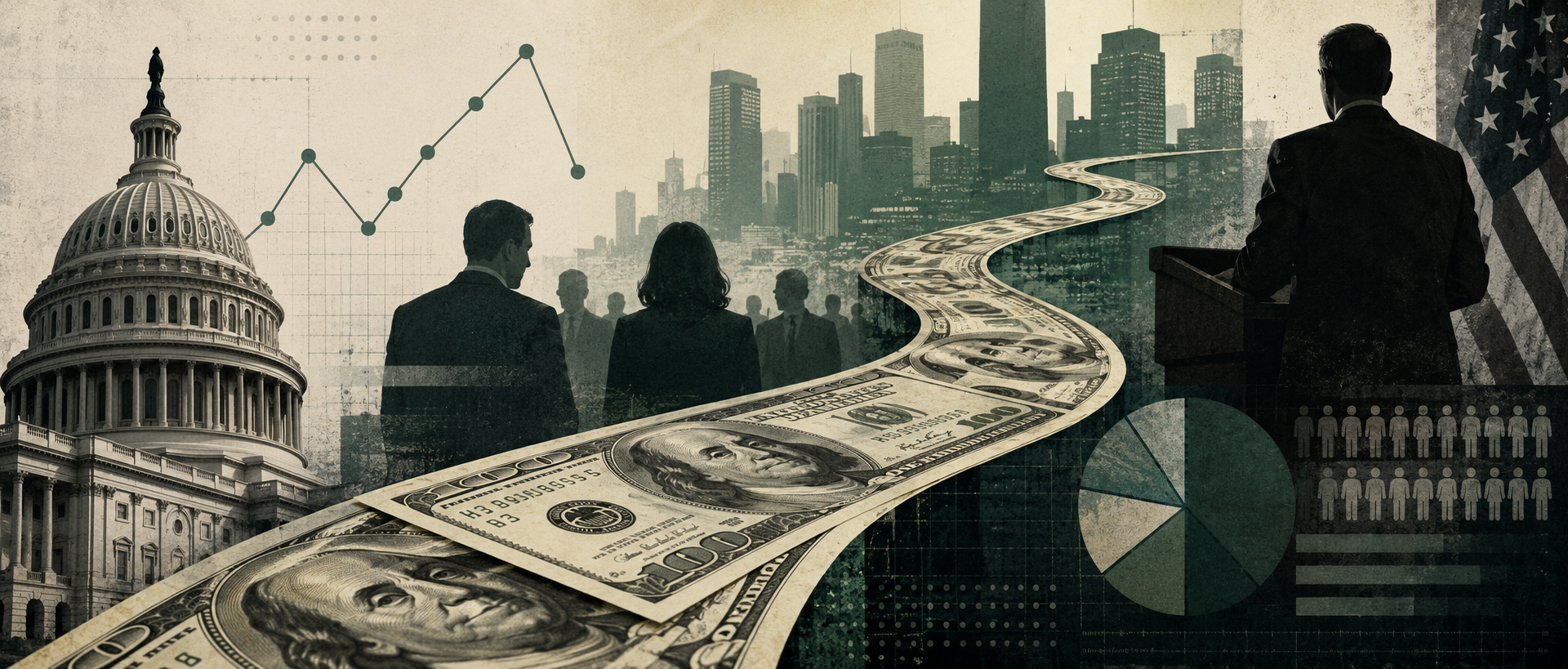
Primaries are happening across the country right now. Some wrapped up in March. Others run all the way through September. Most voters have no idea who's funding the candidates on their ballot.
That isn't a knock on voters. Campaign finance data is technically public, but it's buried in government databases that are notoriously hard to navigate, updated on inconsistent schedules, and filled with raw filing data that takes real work to make sense of.
This post is about why it's worth digging into. Once you understand what the money actually tells you, it changes how you evaluate every candidate.
Every dollar over $200 is on the record
Any donation over $200 to a federal campaign is a matter of public record. Name, employer, occupation, zip code, amount. All of it goes into FEC filings. Most states have similar rules for state-level races.
The data isn't buried in some obscure archive. It's updated regularly and covers every serious campaign in the country.
The issue isn't access. The issue is that the raw data is genuinely painful to work with. The FEC database contains hundreds of millions of records. California's Cal-Access is notorious among researchers for being difficult to navigate, the kind of system that requires technical expertise most campaigns, journalists, and voters simply don't have.
So the data exists. Most people just never see it in a usable form.
The gap between what candidates say and who funds them
Donor data doesn't tell you everything. But it tells you something platforms and speeches can't: where a candidate's financial relationships actually sit.
When we looked at the 2026 California governor's race, we found two Democratic candidates running climate-forward platforms who both accepted maxed-out contributions from Chevron. Same fossil fuel company. Same $39,200 check. Both publicly committed to climate action.
That isn't automatically disqualifying. Politicians build broad coalitions, and money doesn't always translate into influence. But it is a real tension, and it's the kind of thing voters should see before they cast a ballot.
The same pattern turns up everywhere. Candidates running on housing affordability taking real estate developer money. Anti-corporate platforms with tech executives at the legal limit. Grassroots messaging backed by a single billionaire's fortune.
None of it means the candidate is lying. But it does mean the picture is more complicated than the platform suggests. Voters should have the full picture.
The candidate's committee is just the tip of the iceberg
The money in a candidate's official fundraising totals is often not the whole story.
Independent expenditure committees (super PACs, party committees, outside groups) can spend unlimited amounts supporting or opposing candidates, as long as they don't coordinate directly with the campaign. These groups report their spending separately, and the total is often larger than what the candidate raised themselves.
When a candidate says "I raised $5 million," they aren't counting the $8 million a super PAC spent on their behalf. When they say "I have grassroots support," they might. But there's also a well-funded outside group running TV ads for them in every major market.
The full picture means looking at both: what the candidate raised, and what was spent on their behalf. Most voters only ever see the first number.
Primaries are where money matters most
General elections get all the attention. But primaries are where donor influence is most concentrated.
Turnout in a primary is typically a fraction of general election turnout. The electorate is smaller, more engaged, and more ideologically sorted. In that environment, money buys more relative to what the campaign is competing against: more ads, more mail, more name recognition.
It's also the stage where candidates are most dependent on their core donor base. In a general election, a Democrat in California or a Republican in Alabama has a reliable floor of partisan votes. In a primary, they're competing for a narrower audience and more dependent on the financial infrastructure that got them on the ballot.
That dependency matters. The donors who write early checks to primary campaigns aren't just supporters. They're often the reason a candidate is viable at all.
How to actually look this stuff up
If you want to dig into a race yourself, here's where to start.
Federal races: The FEC's website (fec.gov) has filings for every federal candidate. It's functional but not easy to navigate. Search by candidate name and look at "Receipts" to see individual contributions.
California: Cal-Access (cal-access.sos.ca.gov) covers state and local races. It works, but it isn't pretty.
Other states: Most states have a Secretary of State or campaign finance division with a public portal. Quality varies a lot.
The raw data shows you names, employers, and amounts. What takes more work is spotting the patterns: which industries show up repeatedly, how the donor profile compares to the platform, where the outside money is coming from.
That analysis is what BallotBase is built to make easier. We pull from the same raw government filings and turn them into readable campaign finance intelligence, so you can see the whole picture without needing to be a data analyst.
The bottom line
Politicians are going to keep saying the right things. That's the job.
What's different with donor data is that the money doesn't lie in the same way. Donors write checks because they expect something: access, alignment, a friendly regulatory environment, a candidate who shares their values. Sometimes those expectations match what the candidate says publicly. Sometimes they don't.
The data is there. It's public. It covers every serious candidate running for federal and state office. Most voters just never see it in a usable form.
That's the problem worth solving.
What BallotBase Does With This Data
Reading FEC filings is one thing. Turning them into something you can actually hand to a client is another.
BallotBase Money Map is built for political consultants who need analyst-grade race intelligence without the analyst overhead. You pick a race, we pull the full financial picture automatically: total raised, spent, cash on hand, burn rate, self-funding ratio, debt load, PAC receipts broken out from individual contributions, and donor network breakdowns by geography, occupation, employer, and small-dollar vs. large-dollar split.
On top of the raw numbers, Money Map adds an analysis layer. We pull candidate websites for actual platform language and run contradiction analysis, comparing what candidates say against what their donor data shows. The Chevron-meets-climate-platform example from the California governor's race is exactly the kind of thing Money Map surfaces automatically, across every viable candidate in the race.
Independent expenditures get their own section: which organizations are spending for or against each candidate, how much, and when, mapped across the full campaign timeline.
The output is a client-ready PDF briefing, formatted and sectioned with visual stat cards, donor tables, and IE callouts. Every dollar cited to a committee ID and report type, with a methodology disclosure on page one. Something you can put in front of a client without having to explain or apologize for.
If you're a consultant trying to get up to speed on a race, or a campaign trying to understand who's spending against you, request a demo and we'll show you what it looks like on a race you actually care about.
All federal data sourced from FEC filings through the most recent filing date. State data sourced from state campaign finance disclosures. BallotBase pulls from the same raw government exports and updates regularly.